
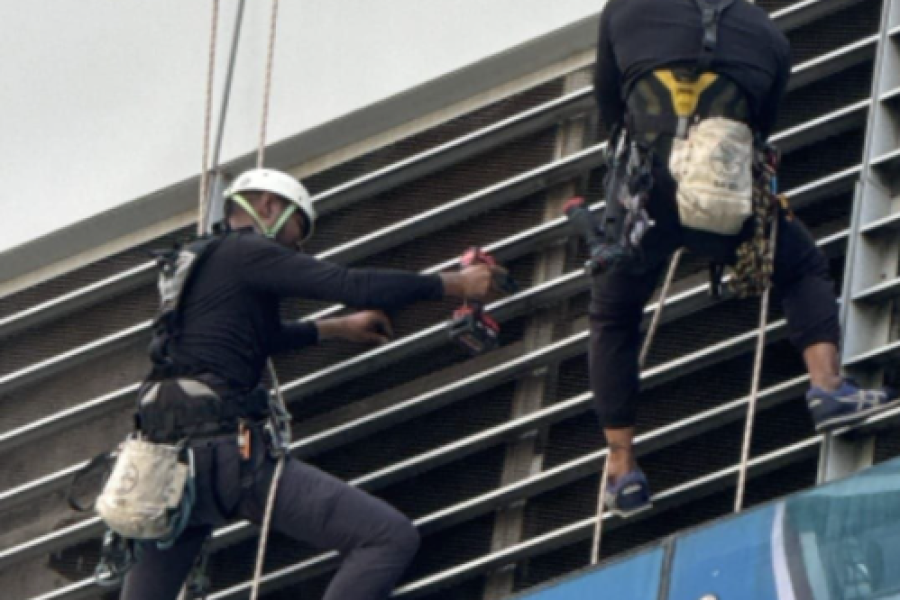
Reinstalling damaged louvres at height can be challenging, particularly when they are located on high-rise buildings or difficult-to-access facades.
Traditional access methods, such as scaffolding, cranes, and elevated work platforms, may be expensive, time-consuming, or impractical.
On the other hand, reinstallation of damaged louvres using a rope access system is efficient, safe, and effective.
Using specialist equipment and trained rope access technicians, damaged louvres can be removed, repaired, repositioned, and securely reinstalled with minimal disruptions to building operations.
Reinstallation of Damaged Louvres Using a Rope Access System
Below, we explain how the process works.
Initial Inspection and Damage Assessment
Qualified rope access technicians assess the condition of the louvres, supporting brackets, mounting frames, fasteners, and surrounding façade. The inspection identifies problems such as:
· Loose, bent, or missing screws and bolts.
· Bent, cracked, or broken louvre blades.
· Corroded mounting brackets and support structures.
· Misaligned or detached louvre panels.
· Damaged sealants and fixing points.
· Structural deterioration affecting the installation.
Planning and Preparation
Before starting the work, a competent team prepares a risk assessment and method statement covering the work area, access arrangements, equipment, environmental conditions, and emergency procedures.
A designated exclusion zone is also established below the working area to protect pedestrians, building occupants, and vehicles from falling objects.
Also read: External Glass Skylight Cleaning at Oasia Resort Sentosa
Accessing the Damaged Louvre Area
The next step in reinstallation of damaged louvres using a rope access system is accessing the damaged area. Once the equipment and safety arrangements have been checked, trained rope access technicians begin descending or ascending the building façade.
Rope access enables technicians to reach restricted areas without installing extensive scaffolding or requiring large lifting equipment.
They can position themselves directly in front of damaged louvres, allowing detailed inspections and controlled repair work.
Removal of Damaged Louvres
Before reinstalling or replacing damaged components, technicians carefully remove the affected louvres.
The removal process involves identifying existing fixing points, checking the stability of adjacent panels, and securing components against accidental movement.
Repairing and Replacing Supporting Components
Before reinstalling the louvres, technicians inspect the supporting framework to ensure it can safely accommodate the components. Any damaged brackets, mounting plates, screws, bolts, or other accessories should be repaired or replaced with suitable materials.
Reinstallation and Alignment of Louvres
Once the supporting structure has been prepared, technicians proceed with reinstalling the louvres.
Each component is carefully positioned according to the original installation arrangement, manufacturer specifications, and approved repair details.
The reinstallation of damaged louvres using a rope access system generally includes:
· Positioning the louvre blade or panel correctly.
· Aligning it with existing mounting framework.
· Installing suitable replacement brackets and fasteners.
· Securing all connections to the specified requirements.
· Checking spacing, alignment, and positioning.
· Confirming that the installed components are stable.
Correct alignment is especially important because poorly positioned louvres can affect ventilation, appearance, water management, and overall performance.
Final Inspection and Quality Assurance
After reinstallation, technicians conduct a final inspection to confirm that the work meets the required quality and safety standards.
The inspection includes checking fastener security, panel alignment, bracket condition, component stability, and the overall appearance of the repaired section.
Any remaining defects should be addressed before the work area is handed back to the building management team. Photographic records and maintenance reports can also be provided to document the completed work.
FAQ
When should damaged louvres be reinstalled or replaced?
Louvres should be inspected when they become loose, bent, detached, corroded, or visibly damaged. Prompt repairs help prevent further deterioration and potential falling-object hazards.
Is rope access suitable for high-rise buildings?
Yes. Rope access is suitable for many high-rise buildings, provided appropriate anchor arrangements, risk assessments, access procedures, and emergency plans are in place.
How long does Louvre reinstallation take?
The duration depends on the number of damaged panels, building height, accessibility, damage severity, and availability of replacement materials.
Reinstallation of damaged louvres using a rope access system provides a practical, efficient, and cost-effective solution. By combining specialist access techniques, thorough inspections, quality materials, and professional installation practices, damaged components can be restored safely and effectively.
At Access Roof Cleaning Singapore, we offer specialized work-at-height and rope access services for commercial, industrial, as well as residential buildings across Singapore.
We focus on delivering safe, practical, and well-executed solutions for projects that require professional access expertise.
Our services include rope access solutions, glass replacement, glazing and installation, canopy, façade and skylight cleaning, and corrosion treatment & painting works. For inquiries, get in touch with us at Access Roof Cleaning Singapore. Our address is 21 Woodlands Close, Primz Bizhub, #06-38, Singapore.
